
X-Men football student-athlete Colin Buffalo shares what Truth and Reconciliation Day means to his family
“September 30th, 2021 is the first National Day for Truth and Reconciliation. It is a day that honors the lost children and survivors of residential schools, their families and communities. Part of the reconciliation process is the survivors telling their painful experiences and ongoing impacts of the residential schools.”

"September 30th, 2021 is the first National Day for Truth and Reconciliation. It is a day that honors the lost children and survivors of residential schools, their families and communities. Part of the reconciliation process is the survivors telling their painful experiences and ongoing impacts of the residential schools."
"Orange T-shirt Day honors the children who survived the residential schools and those who did not. It was a story told by Phyllis Webstad who arrived at a residential school wearing a new orange shirt that was taken from her. It now symbolizes taking away our culture, language, self-esteem and most of all our freedom. Wearing the orange T-shirt honors the survivors of Indian Residential schools," comments Marcia Crier.
Marcia Crier is a residential school survivor. She shared these words through first-year STFX X-Men Football student-athlete Colin Buffalo, from the Samson Cree Nation Reserve in Maskwacis, Alberta. Marcia is Colin's kokum (grandmother), on his mother's side of the family.
 Colin's heritage is three-quarters Cree, and one-quarter Nisga'a, and is heavily tied to his Indigenous culture. Growing up on the reserve with his extended family, he would spend time with them whenever he had the chance.
Colin was raised with the continued tradition of adopting family responsibilities wherein work and family care roles would be divided respectively amongst the parents. "When the time is right, each sex practices entering the role," he shared of that process throughout adolescence.
"When my family heard I was going to go to school, that was a huge accomplishment. I felt like in my community, there were a lot of my family friends saying congratulations. For me, football was the accomplishment. School should not be an accomplishment – it should be the norm."
But that norm does not necessarily hold true.
Both of Colin's parents had plans to pursue degrees that got interrupted by family and life responsibilities. Speaking about his father, Adam Buffalo, Colin explained that he had a choice to make, "work - and help support my mom and sister - or go to school."
Colin's mother Olivia Buffalo was able to finish school and graduate with a degree in psychology a few years later. The interruptions, however, are rooted far deeper, and the inability to pursue an education is not limited to logistics.
Colin shared that his late mosom (grandfather), and namesake, did not want any of his children to go to school – he was scared. Colin's father Adam spoke about the residential schools which "made our people not want to leave, not want to go to school."
Acknowledging that his childhood was much different from his father's, Colin explains that his dad grew up in a hateful, small town rural community, with the Caucasian population sticking together and feeding segregation. Because of that, he hasn't been able to let his guard down.
Just one generation before, Colin's kokums and mosoms were robbed of a childhood altogether, forced to go to residential schools and Indian Day School.
"My experience was being taken from my parents and travelling two days from Northern British Columbia to Edmonton, Alberta," notes his kokum Marcia.
 "The train picked up children along the railroad from Prince Rupert to Hazelton, B.C. Because the schools were full in British Columbia, 200 of us were transported across the province in 1960 to the St. Alberta Residential School. I attended a school in Edmonton where I experienced racism," Marcia recalls of her brutal childhood that had a heartbreaking impact on the entire family.
"The residential school is not an experience that I would like to remember."
Colin's father Adam added, "Imagine having cops take away your little siblings, nephews, etc. around age four, five, six years old - knowing you can't do anything about it and knowing what happened [there]. Physical, mental and sexual abuse, murder, assimilation. Imagine how the parents felt."
He emphasized that, "Residential schools made our people not want to leave our communities, not want to leave for school. My parents, siblings or I don't know my native language because my grandparents were scared of my parents getting beaten for speaking their native language."
Colin's mother Olivia explained that, "When something traumatic happened, they didn't have the opportunity to go to their parents or have their parents tell them that 'it's not OK, or people don't treat people like that.' They had to go to bed or continue going to school, and by the time they went home they might've forgotten or pushed that traumatic memory back, not knowing how to deal with PTSD and all the symptoms."
"This can go into the victim becoming the abuser or ignoring other abuse that's going on in their household because they don't know what to do," she continued. "We have people who were not raised by their parents, they were raised by priests or nuns and they were not parented, they were supervised. So these children grew up that way not knowing how to parent so they raised their own children the same way they were raised. This goes into the cycle of abuse in many forms."
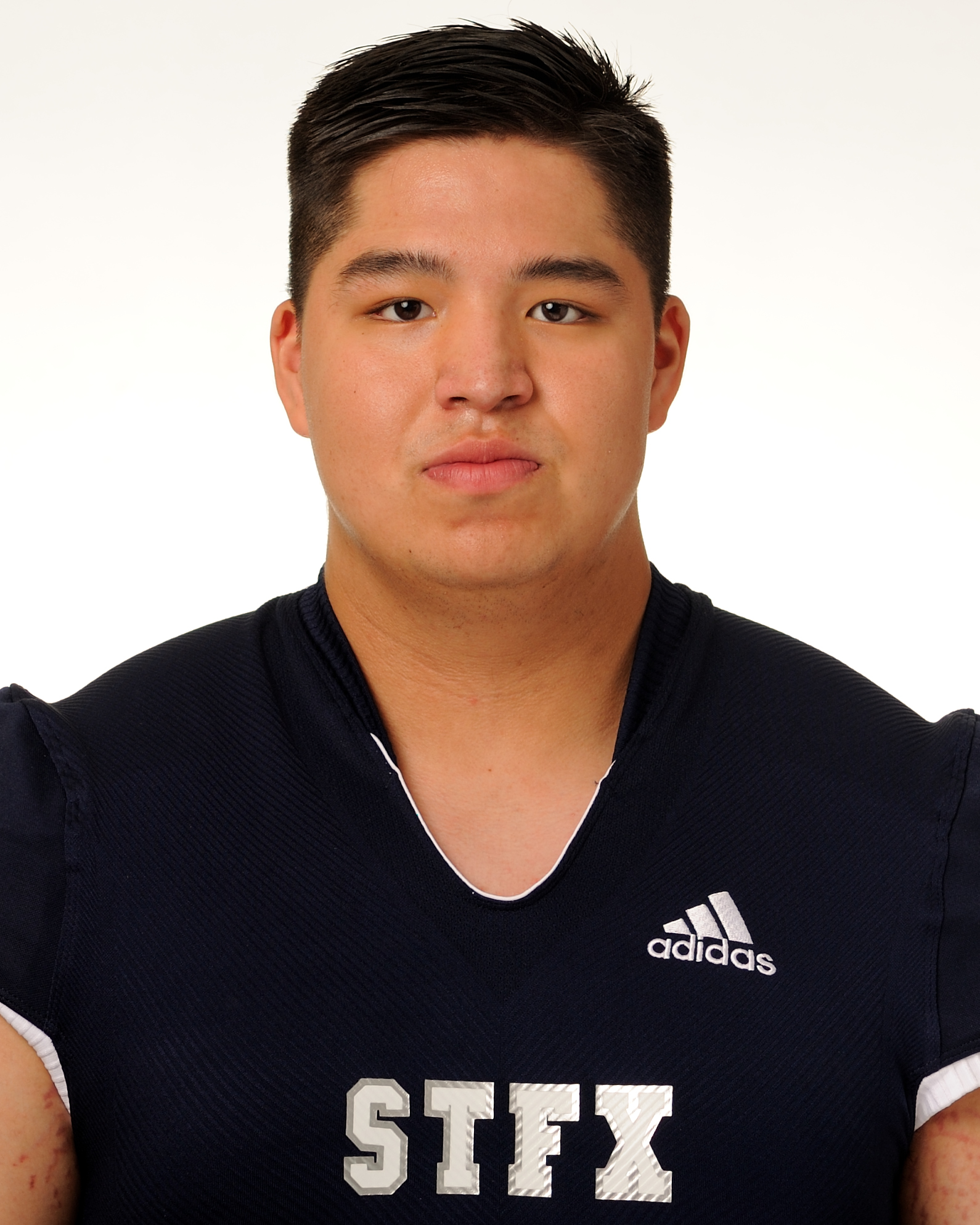 Colin shed light on the cross-generational impact that this abuse has triggered. Sharing that he is only now hearing these stories from his family, Colin communicated the fear and pain associated with talking about the past. His father told him that, "love wasn't shown to my grandparents, so the generation above mine didn't know how to express love to their kids. This is seen today in numerous families not knowing how to express love in a healthy way." What Colin's mosom did do for his children, including Colin's father, was hug and kiss them. He didn't know how to show his love, but he wanted to express it.
While he experienced compassion and love at home, Colin reflected on not being taught about residential schools in the classroom. The stories he now knows of his own family are far contrasts from those previously shared with him through the Caucasian perspectives in the classroom.
Throughout high school, Colin took advanced level classes while being an active member of the school's football team. In classes that were primarily Caucasian students, he had one friend he would always study with because he wasn't alone with him. "I didn't want to put a bad image on my people. Even my teacher knew us, but we didn't know if we would get the benefit of the doubt," he shared.
The football program brought a more diverse environment, and the difference in academic levels between Colin and his teammates (many of whom were Indigenous students taking lower level classes) was insignificant. "I was on the football team – we were all friends."
Finding an outlet through sport is familiar in Colin's family. "My survival was through sports," notes his kokum Marcia. "I tried out for the school sports teams. I loved basketball, fastball, track and soccer," she shared of coping with the horrors that she faced throughout her residential school experience. After raising six children, Marcia earned a degree in social work.
Continuing to pursue both academics and football, Colin decided to come to StFX University to pursue a Bachelor of Arts degree (with a plan to switch to the Human Kinetics program), while playing as an offensive lineman on the X-Men Football team. When asked about his decision to come all the way out to X, he shared that head coach Gary Waterman and offensive line coach Dave van denHeuvel both "made me feel at home."
"My dad always told me 'you don't have to do it for anyone…do it for yourself,'" he explained about his family's support for his move to Nova Scotia.
But Colin is on a mission to be a role model for his younger family members, adding, "Don't be afraid to take that jump. It doesn't matter if you play varsity, rec, Junior B, anything. Do what you love and don't be afraid to leave the community – but don't forget who you are. Be proud of who you are, don't be ashamed."
 The National Day for Truth and Reconciliation embodies an expectation to listen and learn. Speaking to the discovery of thousands of remains of Indigenous children uncovered this summer, Colin added that, "no one should have been shocked by the body count. When you look into it, everyone should have been shocked by how long it took to find them."
"The odds aren't in my favour for me to be where I'm at," Colin's father said.
"Truth and reconciliation is a way of recognizing heritage and ways of life. Damage has been done, [it] cannot repair itself overnight with a signed piece of paper or throwing money at it – meaning settlement of residential/school day school. Healing will never [repair] the hurt of extreme loss of language."
Colin's paternal kokum Wilda Buffalo notes that, "Reconciliation, respect and humanity will help. Children have been stolen, taken away from [the] beauty of family."
For Colin Buffalo's family, the history and its impact is imprinted in a way that forces them to relive and reflect on the horrific events.
"I don't fully understand what happened, what residential schools were, what happened to the kids and what the parents went through," says Colin. "You broadly understand the main goal, but you don't understand the end goal."
"My perspective is going to be different from my dad's, and from my grandparents', and your perspective will be different from mine. But bringing recognition to it, acknowledging it, is a pretty good step forward. It shouldn't have taken this long," concludes Colin.
"If I don't know this history about residential schools, as a young native person, then I assume most Canadians don't know this as well. I ask that you all broaden your minds and learn and try to understand my people."
-30-
Courtesy Iris Magill, StFX Sports Information
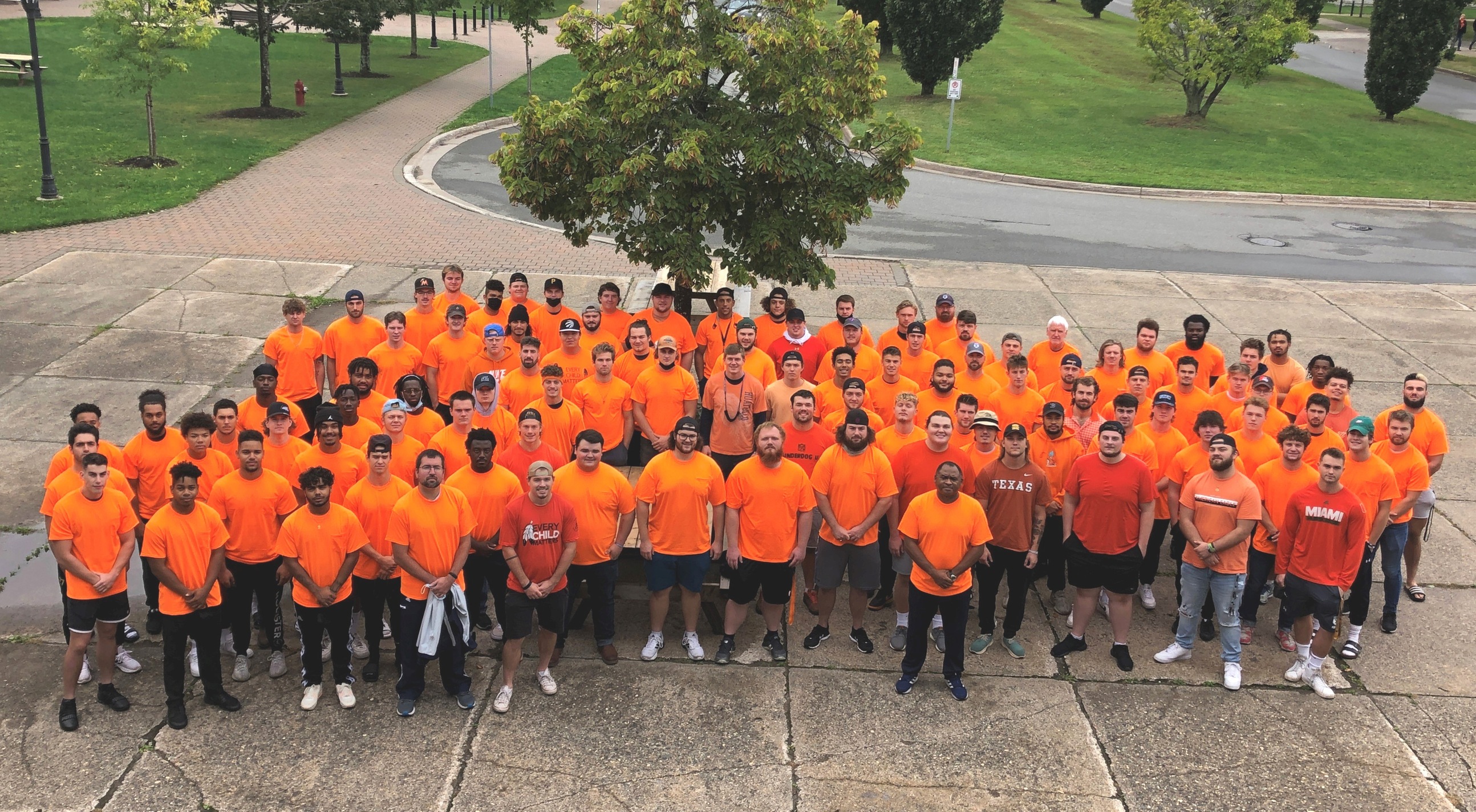
Colin Buffalo and his X-Men Football teammates & coaches honour the first annual National Day of Truth and Reconciliation, Sept. 30, 2021 on the campus of STFX University